Treatise on Persons, People, and the Founding-Era Citizenry
A Historical and Constitutional Rebuttal to the Racial-Caste Theory of American Citizenship
A Rebuttal of Brandon Joe Williams' "A Treatise on the word Person"
Prefatory Statement: Why This Treatise Was Written
This treatise is not written as an attack upon Brandon, nor is it intended as an attempt to discredit his work or diminish the value of sincere historical inquiry. Quite the opposite. Iron sharpens iron. Serious scholarship requires us to test one another's conclusions against the historical record, particularly when those conclusions concern questions as consequential as citizenship, constitutional history, and the political status of a people.
None of us should be above correction. That includes the author of the work examined here, and it includes me.
We have a responsibility to dispense accurate information to the best of our ability. That responsibility becomes even greater when our work reaches the public. Once a historical proposition is repeated enough times, people frequently begin repeating the proposition rather than examining the evidence underlying it. Error can thereby acquire the appearance of established fact simply through repetition.
The consequences are not merely academic. When misinformation concerning citizenship, nationality, constitutional history, or political status enters public discourse, people may construct entire legal and historical theories upon a faulty premise. For that reason, disagreement should not be feared. It should be welcomed when it forces all sides back to the primary sources.
That is the purpose of this treatise.
The central historical question examined here is deceptively simple:
Were free "persons" of African descent capable of being citizens of the several States - and consequently members of the American political community - before the Reconstruction Amendments?
The documentary record examined in the pages that follow demonstrates why that question cannot responsibly be answered by beginning with the Fourteenth Amendment in 1868.
Long before Reconstruction, Americans were already debating the citizenship, political rights, voting qualifications, interstate privileges, and constitutional position of free so-called Black people. More importantly, the historical record contains instances in which free so-called Black persons were treated as citizens under state law, exercised suffrage where state qualifications permitted it, participated in civic life, and were discussed as citizens decades before Dred Scott v. Sandford.
That evidence creates a profound problem for the proposition that so-called Black American citizenship originated with the Fourteenth Amendment.
If free so-called Black persons were already citizens of particular States when the Constitution was adopted, another constitutional consequence follows. The federal Constitution did not create the original States or their citizens. The Constitution was ratified through political communities that already existed. Thus, determining who belonged to those communities before and during ratification becomes indispensable to understanding the original constitutional meaning of “citizen,” “people,” and “citizens of the several States.”
This is precisely why the historical evidence examined here matters.
The proposition being tested is not merely whether nineteenth-century Americans discriminated on the basis of color. They unquestionably did. Nor is the proposition that free Black Americans possessed identical political and civil rights in every State. They unquestionably did not.
Citizenship and equality of rights are separate historical questions.
A citizen could be denied the vote. A citizen could be excluded from an office. A citizen could suffer discriminatory legislation. Women, minors, persons lacking property qualifications, and numerous other citizens experienced restrictions upon particular political rights without thereby ceasing to be citizens.
Consequently, evidence of discrimination against free so-called Black Americans cannot, standing alone, establish their noncitizenship.
This distinction becomes especially important when examining Chief Justice Roger B. Taney's reasoning in Dred Scott. Justice Benjamin Curtis's dissent attacked the historical foundation of the majority's citizenship theory by pointing to free persons of African descent who were citizens of States when the Constitution came into existence. The founding-era constitutions, statutes, electoral qualifications, congressional records, and judicial authorities examined throughout this treatise permit that proposition to be tested against the documentary record rather than accepted merely because Curtis asserted it.
The implications extend beyond Dred Scott.
The Fourteenth Amendment did not originate Black citizenship in America. The historical record demonstrates that free Black citizenship existed before both Dred Scott and Reconstruction. The constitutional significance of that fact - and whether modern citizenship doctrine has improperly obscured an older foundation of American citizenship - is a separate inquiry that deserves independent treatment.
At minimum, the evidence requires a distinction between preexisting citizenship and the Fourteenth Amendment's subsequent constitutional declaration and federal protection of citizenship.
That distinction raises a larger constitutional question:
Did the Fourteenth Amendment create citizenship for a population that previously possessed none, or did its Citizenship Clause constitutionalize and secure at the federal level a status that, for at least some free Black Americans, already existed?
This treatise establishes the historical predicate necessary to ask that question. It does not pretend that the answer automatically resolves every modern Fourteenth Amendment issue. Nor does proof of pre-1868 Black citizenship, by itself, establish that the Fourteenth Amendment is presently illegitimate or legally inapplicable. Those are separate constitutional arguments requiring separate analysis.
But neither should modern Americans be taught that the citizenship of free Black people simply began in 1868 if the historical record demonstrates otherwise.
That misconception has consequences of its own.
The history presented here therefore points toward a second, independent study: whether contemporary discussions of Black American citizenship have become unnecessarily dependent upon the Fourteenth Amendment while overlooking the older constitutional foundation represented by state citizenship, Article IV, the original constitutional structure, and the political communities that ordained and established the Constitution itself.
That inquiry deserves to be undertaken carefully rather than rhetorically.
For now, the purpose is narrower.
We will place the competing propositions beside one another. We will examine what the constitutions actually said. We will examine who could vote. We will examine legislative records. We will examine the Articles of Confederation. We will examine the attempts to insert racial terminology where it had not previously appeared. We will examine judicial decisions rendered before Dred Scott. And we will distinguish citizenship from suffrage, civil rights, political privileges, race, slavery, and social status rather than treating those concepts as interchangeable.
Where Brandon's propositions withstand that examination, they should be acknowledged.
Where they do not, they should be corrected.
And the same standard should apply to this treatise.
Iron sharpens iron.
The objective is not to win an argument against a person.
The objective is to make the historical record win the argument.
A preliminary note on terminology
Throughout this treatise I may occasionally use the expressions “so-called Black,” “so-called white,” “so-called colored,” “Negro,” and similar terminology. The historical terms appear because they are the words used in the constitutions, statutes, judicial opinions, congressional debates, and political literature being examined. My use of “so-called Black” and “so-called white” should not be mistaken for an endorsement of race as a proper marker of human political identity. I do not subscribe to race-based identification as the proper means of identifying peoples. Where racial terminology is necessary to investigate the historical record, I use it descriptively, not normatively.
This distinction matters. The central subject of this treatise is precisely what happens when later commentators mistake historical racial classifications for constitutional first principles.
I. The Question Presented
Brandon Joe Williams's A Treatise on the Word “Person” advances an ambitious thesis. Reduced to its essential propositions, it argues that the original constitutional order contained two fundamentally different classes:
“People” — principally so-called white State citizens who constituted the political sovereignty; and
“persons” — particularly persons of African descent who were outside that original sovereign citizenry.
Williams relies heavily upon Chief Justice Roger Taney's opinion in Dred Scott v. Sandford for this distinction. He then reads the Civil Rights Act of 1866 and the Fourteenth Amendment through Taney's racial classification, concluding that the Fourteenth Amendment created a separate federal or “U.S. citizen” status primarily for formerly enslaved persons, while the original so-called white State citizen remained in a constitutionally different political class.
That is an internally coherent theory if its historical premise is true.
The problem is that the historical premise does not survive contact with the primary record.
This is not merely because Dred Scott was eventually overturned. That response would be too easy and intellectually incomplete. The more consequential problem is that Taney's historical account was demonstrably contestable when he wrote it in 1857, and substantial portions of it were contradicted by:
founding-era State constitutions;
founding-era suffrage laws;
actual political practice;
the Articles of Confederation;
the recorded proceedings surrounding Article IV of the Confederation;
the constitutional ratification structure;
congressional legislation enacted long before the Civil War;
the Missouri admission debates of 1820–1821;
State supreme-court decisions rendered before Dred Scott;
and Justice Benjamin Curtis's evidentiary dismantling of Taney's premise in Dred Scott itself.
The proposition that no person descended from Africans could belong to the original American citizenry is therefore not merely a moral proposition with which modern society disagrees.
It is a historical proposition capable of being tested.
And when tested, it fails.
That failure is devastating to the “person versus people” theory because Williams does not merely cite Dred Scott for a nineteenth-century judicial rule. He adopts Taney's historical explanation as the foundation for a transhistorical constitutional taxonomy. Williams explicitly tells his readers that Taney revealed “entirely different classes” represented by “people” and “persons,” and then carries that alleged distinction into the Civil Rights Act and Fourteenth Amendment.
If Taney's historical premise is wrong, that chain of reasoning breaks at its first substantive link.
This treatise demonstrates why.
II. What I Am — and Am Not — Arguing
Precision is essential here.
I am not arguing that every free person of African descent in every State possessed identical rights in 1787.
They did not. I am not arguing that racial discrimination did not exist at the founding.
It plainly did.
I am not arguing that citizenship, suffrage, officeholding, militia eligibility, jury service, marriage, property ownership, and social equality were interchangeable concepts.
They were not.
And I am not arguing that the constitutional meaning of national citizenship before 1868 was as fully defined as it became after the Fourteenth Amendment. It was famously unsettled.
The proposition established by the evidence is considerably narrower—and considerably harder to escape:
Free persons of African descent were legally recognized as members of the citizenry in multiple States that formed the original Union, and in several of those States qualified free Black men possessed the franchise on substantially the same constitutional terms as other qualified electors.
Justice Curtis identified New Hampshire, Massachusetts, New York, New Jersey, and North Carolina. He concluded that free native-born persons of African descent were citizens there and that those satisfying the additional electoral qualifications could vote.
That fact is enough to destroy a categorical proposition that persons descended from Africans were necessarily outside the founding political community.
Curtis framed the point with remarkable precision:
If free people of African descent were State citizens at the founding, and those State citizens formed part of the political communities that adopted the Constitution, then one cannot simply assert that the Constitution was exclusively made by a white political people.
His conclusion was not that racial equality existed. His conclusion was that Taney's universal exclusion was factually false.
That distinction will control everything that follows.
III. Williams's Foundational Error: Treating Dred Scott as Historical Proof Rather Than a Contested Historical Argument
Williams accurately reproduces portions of Taney's opinion. The difficulty arises in what he does with them.
Taney stated that the words “people of the United States” and “citizens” described the political community exercising sovereignty. Williams then highlights Taney's conclusion that descendants of Africans brought here as slaves were not included within that body and treats Taney's distinction between “people” and the “class of persons” before the Court as revealing a constitutional distinction between the words themselves.
But that reasoning commits a fundamental methodological error.
Taney did not establish that the noun person was constitutionally defined as “African noncitizen.”
He used the ordinary word person while asking whether a particular class of persons belonged to the political category citizen.
Those are completely different propositions.
Consider the logical structure:
Some persons are citizens.
Some persons are aliens.
Some persons were enslaved.
Some persons were officeholders.
None of those propositions means that the word person itself denotes the second, third, or fourth legal class.
Williams takes a description of a class of persons and converts it into a lexical definition of person.
Nothing in Dred Scott supports that transformation.
Indeed, Williams himself acknowledges that “person,” “people,” and related terms had historically been used in overlapping ways before Taney.
The supposed racial definition therefore comes not from the Constitution's original semantic usage but from Williams's reading of Taney's characterization of a litigant class in 1857.
That is the first structural defect.
The second is worse: Taney's characterization of the founding citizenry was historically contested by the evidence available in his own case.
IV. The January 11, 1866 Congressional Debate: A Claim-by-Claim Historical Audit
The Congressional Globe for January 11, 1866, pages 196–207 is unusually valuable because it stages almost the exact argument we are having today.
Representative Andrew J. Rogers of New Jersey defended a historical position substantially sympathetic to Taney's account. Representative William D. Kelley of Pennsylvania, together with other members, challenged its factual foundation.
This was not a twenty-first-century reinterpretation. It occurred nine years after Dred Scott and before final adoption of the Fourteenth Amendment.
The following separates historically testable assertions from legal argument and rhetoric.
A. Page 196: Rogers's foundational historical claims
Claim 1: The original American political community was understood as exclusively white.
Rogers's argument repeatedly assumes that those who framed the Declaration and Constitution regarded political government as belonging exclusively to white men.
Finding: contradicted as a categorical historical proposition.
The founding States certainly imposed numerous exclusions, but multiple constitutions used race-neutral electoral terminology. New Jersey's 1776 Constitution extended voting to “all Inhabitants” satisfying age, property, residence, and estate requirements. The New Jersey State Archives reproduces that language.
New York's 1777 Constitution gave the Assembly franchise to “every male inhabitant of full age” satisfying the prescribed residence/property or tax qualifications. It inserted no racial limitation.
North Carolina's 1776 Constitution gave the franchise to “all freemen” meeting age, residence, property, or tax qualifications. Again, the provision contained no racial adjective.
New Hampshire's original 1784 constitutional language provided that “every inhabitant” possessing the proper qualifications had an equal right to elect and be elected.
Massachusetts's governmental history likewise contradicts categorical exclusion: the State's official historical account notes that the rejected 1778 constitution would have excluded free African Americans from voting, whereas the 1780 Constitution did not contain that exclusion.
Justice Curtis summarized the resulting practice: free native-born persons of African descent in New Hampshire, Massachusetts, New York, New Jersey, and North Carolina were State citizens, and those otherwise qualified exercised the franchise.
A universal claim therefore fails.
Claim 2: Dred Scott had established that persons descended from Africans were not part of the constitutional people.
Finding: accurate as a description of Taney's holding; not independently established as historical fact.
That distinction is crucial.
The Supreme Court unquestionably rendered Dred Scott, and Taney unquestionably adopted that historical interpretation. The official U.S. Reports preserves both the majority opinion and Curtis's dissent.
But citation to a judicial opinion proves what the Court held, not necessarily that every historical premise supporting the holding was correct.
That is exactly what Kelley challenged.
Claim 3: The Declaration-era political order treated Black persons only as slaves or outsiders.
Finding: materially overbroad.
Large numbers of persons of African descent were enslaved. That fact is beyond serious dispute.
But the existence of slavery does not establish that every person of African descent was enslaved or politically excluded.
Curtis's dissent, drawing upon State constitutions and judicial decisions, expressly identified free Black State citizens.
A contemporary critique published immediately after Dred Scott likewise attacked the majority for reducing the historical population to only white citizens and enslaved Africans, noting a substantial free Black population with civil and, in some colonies, electoral rights.
That newspaper is not controlling legal authority. Its significance is different: Taney's historical narrative was being publicly disputed on factual grounds in 1857 itself.
V. Pages 196–197: Kelley Places the Historical Question Squarely on the Record
Kelley's intervention is one of the most important moments in the twelve-page debate because he refuses to argue at the level of abstraction.
He asks, in substance:
Were free colored men actually citizens and voters when the Constitution was formed?
That is the correct historical inquiry.
The validity of the answer does not depend upon what either Rogers or Kelley believed in 1866. We can test it.
And we will.
VI. New Jersey: Perhaps the Clearest Refutation of Categorical Racial Citizenship
New Jersey is particularly destructive to a rigid “white people versus Black persons” constitutional theory because the documentary record is unusually clear.
The 1776 Constitution
The operative qualification was:
“all Inhabitants of this Colony of full Age” possessing £50 proclamation money in clear estate and satisfying the residence requirement.
No “white” limitation appears.
New Jersey's own official historical account states expressly that the first constitution permitted property owners to vote, including free Black men and some women. The State later restricted voting in 1807 to free white male citizens.
That temporal sequence matters.
If the original constitutional words already meant “white citizen,” there would have been little reason to subsequently enact a racial restriction.
The insertion of a racial qualification is evidence that the earlier category was broader.
New Jersey's official historical materials go further: later election statutes used “he or she”, confirming that the broad wording was not merely a drafting accident. The 1807 legislature then consciously narrowed the electorate to white male citizens.
Therefore:
Before 1807, free Black men satisfying the neutral constitutional qualifications could belong to the New Jersey electorate.
That alone makes Taney's categorical claim impossible to sustain in its strongest form.
VII. New York: The Constitution Said “Every Male Inhabitant,” Not “Every White Male”
Article VII of New York's 1777 Constitution provided that:
“every male inhabitant of full age”
who met the residence and property/tax requirements could vote for representatives.
There is no racial qualification in the clause.
Curtis relied on this exact language in his dissent and noted that later New York constitutional amendments imposed special property requirements on colored voters that had not previously existed.
The historical sequence again matters.
A later racial restriction is not evidence that the earlier law contained one.
It is evidence that lawmakers added one.
An 1839 newspaper account uploaded with the materials discusses precisely this transition, reporting that under the old New York Constitution no racial distinction had existed in the qualification of electors and describing the subsequent 1821 convention's treatment of Black suffrage.
This is not merely modern revisionism.
It is nineteenth-century political memory discussing an alteration that had occurred less than two decades earlier.
VIII. North Carolina: Here the Judicial Record Becomes Devastating
The strongest evidence is not merely North Carolina's 1776 constitutional text.
It is the North Carolina Supreme Court.
The original constitution gave voting rights to “all freemen” satisfying the prescribed qualifications.
Then came State v. Manuel.
State v. Manuel, 20 N.C. 144 (1838)
Justice William Gaston explained the State's law in unmistakable terms. Curtis quoted the decision at length.
The court's doctrine was that:
free persons born within North Carolina were citizens;
color did not create a third class between citizen and alien;
manumitted persons born within the State became free citizens;
and free persons of color had historically exercised the franchise until the State's amended constitution removed it.
Curtis reproduced Gaston's conclusion that free persons “without regard to color” had claimed and exercised the franchise until disfranchisement.
This is enormous.
Why?
Because State v. Manuel was decided in 1838.
That is nineteen years before Dred Scott.
Taney therefore was not writing upon a blank historical canvas in 1857.
A State supreme court had already declared that free native-born Black North Carolinians were citizens and had participated electorally under the original State constitution.
State v. Newcomb, 27 N.C. 250 (1844)
Six years later, the same court referred back to Manuel, emphasizing the seriousness with which it had been considered and giving it controlling influence on similar questions. Curtis expressly relied upon that reaffirmation.
Again, this preceded Dred Scott.
Thus when Taney spoke in universal terms, there already existed contrary reported judicial authority from an original State.
IX. Massachusetts: Another Serious Problem for Taney's Universality
Massachusetts provides a different but equally important evidentiary chain.
The Commonwealth's official history states that the proposed 1778 constitution would have expressly permitted slavery and excluded free African Americans from voting. Massachusetts voters rejected that constitution. The Constitution adopted in 1780 instead declared that “all men are born free and equal” and did not reproduce the proposed racial voting exclusion.
Curtis stated even more directly that persons of African descent born in Massachusetts were citizens under the 1780 Constitution and that qualified persons had exercised the elective franchise.
The importance is methodological:
An express racial exclusion was contemplated in one proposed constitutional regime and absent from the constitution actually adopted.
That does not automatically prove every imaginable right.
But it is extraordinarily difficult to reconcile with the claim that everyone simply understood political citizenship to be racially exclusive without needing words to say so.
X. New Hampshire: “Every Inhabitant”
New Hampshire's 1784 Constitution declared:
“All elections ought to be free, and every inhabitant of the State, having the proper qualifications, has equal right to elect and be elected into office.”
New Hampshire's Supreme Court has reproduced this founding language in its modern constitutional jurisprudence.
Curtis listed New Hampshire among the States in which free persons of African descent were citizens and qualified electors.
Again, the proposition established is not universal equality.
It is that race was not embedded as an indispensable constitutional element of citizenship or electoral eligibility in the manner Taney's broad theory requires.
XI. Maryland and Pennsylvania: Why a Serious Scholar Must Include the Harder Evidence Too
A persuasive treatise cannot simply collect favorable examples.
The States did not speak with one voice.
That is part of the point.
Maryland's 1776 Constitution spoke broadly of “all freemen” meeting property, age, and residence requirements. Later Maryland constitutional changes expressly limited suffrage to “every free white male citizen.”
Pennsylvania's 1776 declaration likewise spoke of “all free men” having sufficient common interest and attachment to the community.
But Pennsylvania later produced legal controversy over whether Black inhabitants were constitutionally “freemen” for voting purposes.
That complexity does not rescue Taney. It undermines him.
Why?
Because Taney's thesis was categorical.
A genuinely mixed founding record—some States recognizing Black citizenship and political participation, others restricting it, and still others generating later disputes—cannot rationally support:
No member of the class could belong to the American political people.
The appropriate historical conclusion is:
Citizenship and suffrage varied by State, and free Black political membership existed in multiple founding jurisdictions.
That conclusion is considerably less dramatic than Taney's.
It is also considerably better supported.
XII. The Articles of Confederation: The “White” Amendment That Failed
This is one of the most powerful pieces of evidence in the entire controversy.
Article IV of the Articles of Confederation provided privileges and immunities for the:
“free inhabitants”
of the several States, subject to stated exceptions.
During consideration of the Articles, South Carolina proposed inserting the word “white” so that the language would apply to “free white inhabitants.”
The proposal failed.
Curtis recorded the vote:
two States in favor;
eight against;
one divided.
The language remained “free inhabitants.”
Curtis did not treat this as a modern moral symbol.
He made a precise textual argument:
If the political actors knew how to write white when they wanted a racial limitation, and such a limitation was affirmatively proposed and rejected, a court should hesitate before later inserting that limitation by implication.
That is exceptionally powerful.
It also destroys one of the easiest defenses of Taney:
“Maybe everyone simply assumed ‘free inhabitants’ meant white.”
No.
Someone explicitly proposed changing it to “free white inhabitants.”
The political body declined.
Whatever one thinks the rejection ultimately proves about every imaginable privilege, it indisputably proves that racially restrictive language was available, understood, and debated.
Curtis then connected this history to Article IV of the Constitution. The Confederation's “free inhabitants” formulation became the Constitution's privileges-and-immunities guarantee for “Citizens of each State.” He reasoned that the transfer supplied no new racial exclusion.
That is a textual-historical argument Taney never successfully neutralized.
XIII. The 1820 Missouri Debate: The Question Existed Thirty-Seven Years Before Dred Scott
The debates from the Sixteenth Congress, Second Session, concerning Missouri's admission, is particularly important because it demonstrates something often lost in later summaries:
Congress was openly debating Black State citizenship and Article IV in 1820.
Missouri's proposed constitution directed its legislature to prevent “free negroes and mulattoes” from entering and settling in the State.
The constitutional objection was immediate:
What if some of the excluded free Black persons were citizens of other States?
If so, Missouri's blanket exclusion might collide with Article IV's command:
“The Citizens of each State shall be entitled to all Privileges and Immunities of Citizens in the several States.”
The debate reflected competing positions.
One side argued that free Black persons could indeed be citizens in States whose laws recognized them as such and that Missouri therefore could not simply exclude the entire racial class.
The opposing side argued that whatever local rights free Blacks enjoyed did not necessarily amount to the citizenship contemplated by the federal Constitution.
That is precisely the dispute later presented in Dred Scott.
And it existed in recorded congressional proceedings decades earlier.
Curtis relied upon the eventual Missouri settlement. Congress admitted Missouri upon the fundamental condition that its constitution never be construed to authorize exclusion of any “citizen of either of the States” from privileges and immunities secured by the Constitution. Curtis explained that the episode reflected Congress's understanding that free Black persons as citizens of some States could possess Article IV rights.
This is highly damaging to the Williams/Taney historical narrative.
It proves at minimum that by 1820 it was not universally accepted that free Black people necessarily stood outside constitutional citizenship.
Quite the contrary:
Congress had to confront the question because Black State citizenship was a real legal problem, not a hypothetical invention of Reconstruction.
XIV. “But Could They Vote?” Citizenship Is Not the Same Thing as Suffrage
This is where many discussions become conceptually confused.
A person can be a citizen without possessing every political privilege.
Curtis dealt directly with this.
Naturalized citizens were unquestionably citizens, yet:
they could not immediately become Senators;
they could not immediately become Representatives;
they could never become constitutionally eligible as natural-born Presidents merely through naturalization.
Women were citizens while generally excluded from voting.
Minors were citizens.
Persons lacking prescribed property qualifications could be citizens without voting.
Residents of territories could possess American citizenship without representation in Congress.
Therefore:
Citizenship cannot logically be defined as possession of every franchise enjoyed by the most politically privileged citizen.
Curtis makes this point expressly.
This distinction is fatal to an argument that reasons:
Black people sometimes lacked suffrage → therefore Black people could not be citizens.
The premise does not entail the conclusion.
Just as:
Women could not vote → women were not citizens
would be historically absurd.
Indeed, even at the founding, white male citizens themselves frequently faced property, tax, residence, age, and other voting qualifications.
The electorate was not coextensive with the citizenry.
That fact alone makes voting restrictions a poor universal test of citizenship.
XV. Ratification and “We the People”: What Can Actually Be Proved?
This question deserves special care because overclaiming would weaken an otherwise formidable argument.
Curtis stated that in States where free colored persons possessed the franchise, they were legally among those empowered to act upon ratification and “doubtless did act” through their suffrages.
What does the evidence establish beyond reasonable dispute?
It establishes that:
The Constitution was ratified through State conventions.
The selection of convention delegates depended upon State electoral law.
In several States, those electoral laws did not contain a racial exclusion and permitted qualified free Black men to vote.
Therefore qualified free Black electors were legally part of at least some political communities participating in the constitutional adoption process.
What should we not claim without a surviving poll list?
We should not casually assert that a specifically named Black voter personally cast a ballot for a particular ratification delegate unless the underlying poll record establishes it.
That distinction matters.
Legal eligibility is proven more easily than individual ballot casting.
Yet Taney's theory still fails at the first level.
If free Black men were legally members of the electorate selecting representatives in the constitutional political system, they cannot simultaneously be described as a class universally incapable of membership in that political society.
That contradiction does not require discovering the name on every ballot.
XVI. The Most Important Pre-Dred Scott Judicial Authorities
1. State v. Manuel, 20 N.C. 144 (1838)
As discussed above, Manuel recognized free native-born persons of color as North Carolina citizens and acknowledged their prior exercise of suffrage.
2. State v. Newcomb, 27 N.C. 250 (1844)
The North Carolina Supreme Court reaffirmed Manuel as a carefully considered authority.
3. Commonwealth v. Aves, 35 Mass. (18 Pick.) 193 (1836)
Curtis relied upon Chief Justice Shaw's Massachusetts jurisprudence when discussing both status and Massachusetts political history. The case is important because it demonstrates the legal system's recognition of freedom and civil status independent of Taney's later universalized racial theory.
4. Gassies v. Ballon, 31 U.S. (6 Pet.) 761 (1832)
Curtis cited Gassies for the relationship between United States citizenship, residence, and State citizenship for federal diversity jurisdiction.
5. McIlvaine v. Coxe's Lessee, 8 U.S. (4 Cranch) 209 (1808); Inglis v. Trustees of Sailor's Snug Harbour, 28 U.S. (3 Pet.) 99 (1830); Shanks v. Dupont, 28 U.S. (3 Pet.) 242 (1830)
Curtis invoked these authorities to support the founding understanding that allegiance and citizenship could arise from birth and from the political transition from British subjectship to State citizenship following independence.
This matters because Curtis did not invent a citizenship theory from moral philosophy.
He built it from:
text + State law + common-law concepts + prior judicial authority + actual constitutional practice.
That method is materially more evidentiary than Taney's sweeping sociological generalizations.
XVII. Federal Statutes Before Dred Scott Also Complicate Taney's Racial Absolutism
Curtis pointed to several federal statutes whose wording makes little sense if the word citizen inherently meant “white person.”
Consider the Militia Act of 1792.
Congress required enrollment of:
“every free, able-bodied, white male citizen”
within the statutory class.
Why say white citizen if citizen already means white?
The adjective performs work.
If “citizen” itself contained an inherent racial limitation, “white” would be redundant in precisely the way that saying “unmarried bachelor” is redundant.
Curtis expressly made this point.
Even more revealing is the Act of February 28, 1803, which referred to:
“any negro, mulatto, or other person of color, not being a native, a citizen, or registered seaman of the United States.”
The statute's grammar contemplates that a person of color might be a citizen.
Curtis did not pretend that these statutes settled the entire constitutional question. His argument was narrower and stronger:
They are inconsistent with the notion that Congress universally understood color to be an indispensable semantic component of citizenship.
XVIII. Naturalization Does Not Prove What Williams Says It Proves
Williams begins his treatise with the Naturalization Act of 1790 and its limitation to a “free white person.” He then builds toward the proposition that the original political citizenry was white. He also states that the 1802 enactment is the “version that is currently active,” and asserts that before 1866 there was only State citizenship in the relevant sense.
There are multiple problems here.
Most fundamentally:
Naturalization concerns aliens.
It does not answer who was a native-born citizen.
That is exactly Curtis's response.
Congress's power to establish a uniform rule of naturalization addressed the removal of foreign-birth disabilities. It did not logically determine whether a native-born free Black person recognized as a citizen by New Hampshire, Massachusetts, New York, New Jersey, or North Carolina could be a citizen.
So:
Congress limited naturalization of foreign aliens to “free white persons”
does not entail:
Every native-born nonwhite person was constitutionally incapable of citizenship.
Those are separate legal questions.
Curtis additionally pointed out that the Constitution itself did not racially restrict Congress's naturalization power and that citizenship had been extended through treaties to populations who would not fit a simplistic “European white person” category.
The naturalization argument therefore commits a category error:
rules governing conversion of aliens into citizens are being used to define the status of people who were not aliens.
XIX. The Fourteenth Amendment Did Clarify National Citizenship — But That Does Not Prove There Was No National Citizenship Before It
This is another place where Williams begins with a true proposition and reaches a much larger conclusion than the authority supports.
The Slaughter-House Cases correctly observed that the original Constitution contained no comprehensive definition of citizenship comparable to Section 1 of the Fourteenth Amendment. Williams quotes that passage.
That is true.
But:
“The Constitution did not previously contain a complete constitutional definition”
does not mean:
“No citizenship of the United States existed before 1868.”
The original Constitution itself used the phrase:
“Citizen of the United States”
including in presidential eligibility.
Curtis's dissent begins precisely by asking who those citizens were at the time the Constitution itself referred to them.
Moreover, the Library of Congress's Constitution Annotated explains that the Citizenship Clause was understood by its sponsor as declaratory of what he regarded as already existing law: every person born within the United States and subject to its jurisdiction was a citizen.
That does not mean everyone in 1866 agreed.
They plainly did not.
It means the historical record cannot be reduced to:
Congress invented an entirely new racial federal-citizen caste in 1868.
The Fourteenth Amendment did something enormously important:
It constitutionalized a uniform national rule, repudiated Dred Scott's racial exclusion, and prevented States from controlling citizenship in the manner previously disputed.
That is not the same as inventing the concept of American citizenship from nothing.
XX. The Civil Rights Act of 1866 Actually Cuts Against the “Person Means Negro” Theory
Williams places great emphasis on the Civil Rights Act's formulation:
“all persons born in the United States ... are hereby declared to be citizens,”
followed by protection of those citizens “of every race and color” to the same rights enjoyed by white citizens. He infers that “persons” identifies the nonwhite class while “white citizens” identifies the original sovereign class.
But grammatically, the statute says something quite different.
Its logical structure is:
all qualifying persons → are citizens → such citizens, of every race and color → receive equal civil rights.
The phrase “of every race and color” would be unnecessary if “persons” itself meant the Black racial class.
Even more decisively, “white citizens” appears as the statutory comparator for equal rights:
the protected citizens are to enjoy the same specified civil rights that white citizens enjoy.
A comparator is not necessarily a separate citizenship species.
If a statute says:
female employees shall receive the same benefits as male employees,
it does not establish two ontologically different species of “employee.”
It identifies a benchmark against which discriminatory treatment is measured.
That is what the Civil Rights Act's syntax does.
Williams transforms an equality comparator into a constitutional caste taxonomy.
The text does not support that transformation.
XXI. “Person” Cannot Be a Racial Constitutional Term Because the Constitution Uses It Far More Broadly
There is an even more basic textual problem.
The Constitution uses person repeatedly in contexts that cannot possibly mean “Black noncitizen.”
For example, the Constitution speaks of persons:
counted for representation;
held to service;
accused or convicted;
elected or appointed;
subject to legal process;
migrating or imported;
and holding constitutional offices or rights in various contexts.
The Fourteenth Amendment itself says:
no State shall deprive any person of life, liberty, or property without due process;
and:
nor deny to any person within its jurisdiction the equal protection of the laws.
If “person” meant Williams's alleged racial class, then due process and equal protection would textually exclude white persons.
No serious constitutional doctrine has ever treated the Due Process Clause that way.
Williams's theory therefore produces an absurd semantic result:
the very word he says designates the special Black class is the universal legal noun used to protect human beings irrespective of citizenship.
The distinction is not:
people = white
persons = Black
The real distinction is closer to:
person = human/legal individual
citizen = person possessing a particular political status
people = collective political body, with meaning dependent upon context
Those categories overlap.
They are not racial antonyms.
XXII. Taney's Historical Method Versus Curtis's Historical Method
This is where the contrast becomes especially stark.
Taney proceeds principally from broad claims about prevailing racial opinion.
His language is sweeping:
attitudes were “fixed and universal”;
Black persons were generally regarded as inferior;
the white race allegedly constituted the political community;
descendants of enslaved Africans were not intended within “the people.”
Williams reproduces and depends heavily upon those propositions.
Curtis asks different questions:
What did the constitutions actually say?
Who could actually vote?
What did State courts actually hold?
What language was proposed and rejected?
What did Congress actually enact?
How did Congress confront Black State citizens when Missouri sought to exclude them?
That is why Curtis's argument is more empirically grounded.
He does not ask us to deny racism.
He asks us to distinguish racial prejudice from legal status.
That is jurisprudentially essential.
A society may discriminate brutally against members of its own citizenry.
Discrimination does not automatically erase citizenship.
American history itself demonstrates that repeatedly.
XXIII. Taney's Internal Logical Difficulty
Taney's opinion contains a structural proposition that makes Curtis's evidence especially damaging.
Taney reasoned that those recognized as citizens of the several States at the constitutional founding became members of the new political body.
Curtis then asks the obvious factual question:
Were free Black persons citizens of any of those States?
If the answer is yes, Taney's own general framework creates a problem for his categorical racial exclusion. Curtis's evidence says yes. Not everywhere. But in multiple States.
Therefore Taney needs an additional rule:
State citizens of African descent somehow did not count, even though other State citizens did.
Where is that racial exception written? Not in the citizenship qualifications of Article III. Not in Article IV. Not in the Preamble. Not in Article II's reference to citizens existing at adoption.
It has to be supplied from Taney's historical generalization.
And that historical generalization is precisely what the State constitutions and practice contradict.
That is the circular weakness at the heart of the majority.
XXIV. Rogers's January 1866 Claims: Final Audit
For clarity, the major historically testable propositions emerging from Rogers's twelve-page presentation and the responses to it can be summarized as follows:
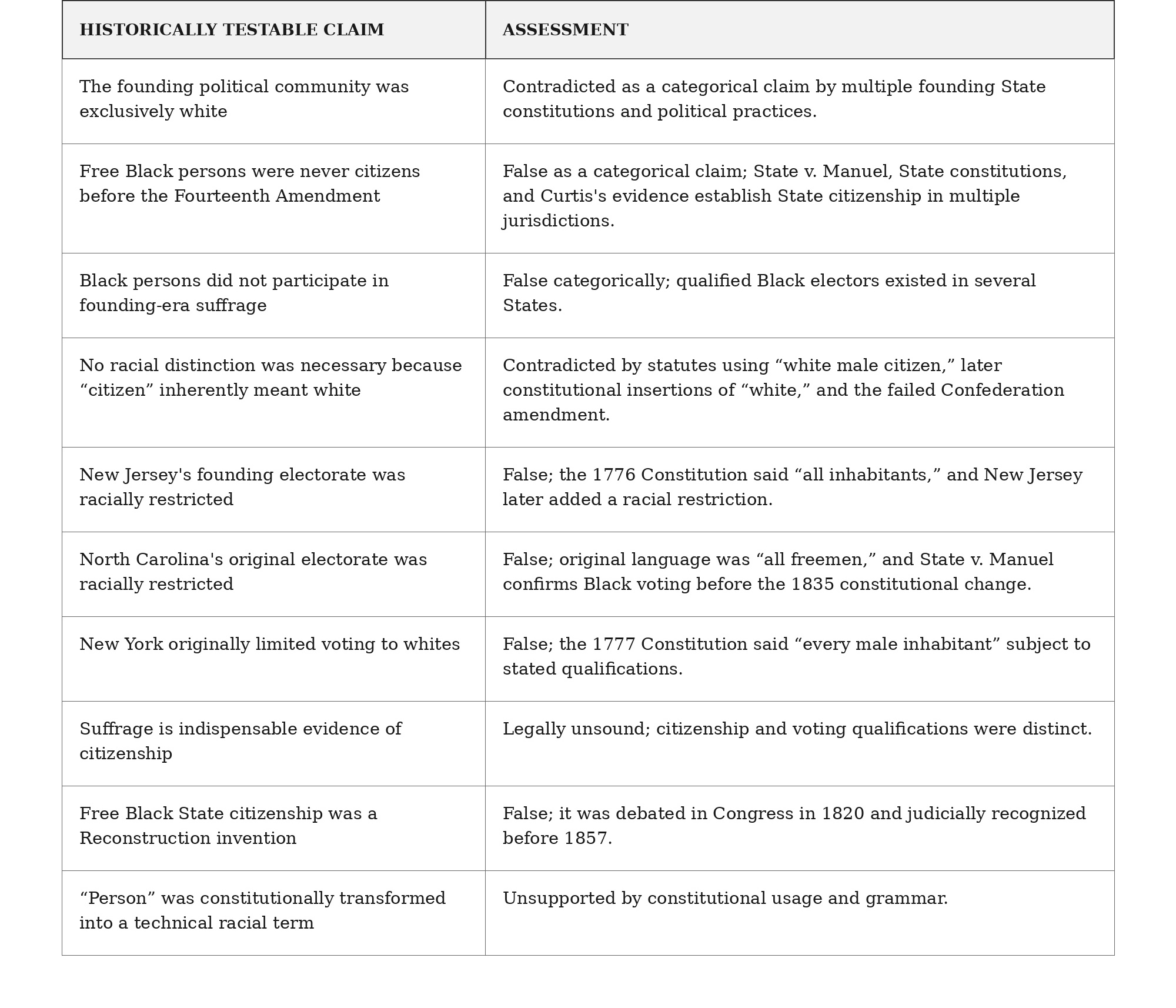
There were also peripheral factual disputes in the twelve pages concerning militia enrollment, Civil War service, State racial legislation, particular elections, census numbers, and regional voting patterns. Several were rhetorical or anecdotal and cannot responsibly be established merely from the Congressional Globe. They should therefore not be used as foundation stones for the constitutional argument without independent corroboration.
That is itself an important methodological lesson:
The strongest rebuttal does not need every statement by Kelley or Farnsworth to be correct.
It requires only that the documentary evidence independently defeat Rogers's and Taney's categorical racial proposition.
It does.
XXV. Ten Questions the Taney/Williams Theory Must Answer
These should not be presented as “gotchas.” They are historical and constitutional interrogatories. A defensible theory should be capable of answering each one.
If free persons of African descent were legally recognized as citizens and qualified electors in multiple founding States, how can it be maintained that the entire class was necessarily excluded from the constitutional citizenry?
If qualified free Black State citizens participated in the same political communities through which the Constitution was adopted, upon what constitutional text are they excluded from the founding “people”?
If the original States possessed authority over the status of their native-born citizens, where does the original Constitution give the federal judiciary power to erase the citizenship those States recognized solely because of ancestry?
If possession of the franchise is indispensable to citizenship, were women, minors, naturalized citizens temporarily ineligible for federal office, and propertyless white men noncitizens?
If the Confederation Congress considered and rejected a proposal to insert “white” before “inhabitants,” why should a later court insert essentially the same racial limitation by implication?
Where does the original Constitution actually say that a person of African descent cannot be a citizen?
If Dred Scott concluded that federal jurisdiction was absent because Scott could not be a citizen, by what principle should the Court then have proceeded to adjudicate the constitutional validity of the Missouri Compromise?
If the federal government possessed an unwritten power to select which classes of native-born State citizens counted as United States citizens, what textual limitation prevented that power from being used against any disfavored native-born class?
If a free Black native-born Massachusetts citizen crossed into another State, what constitutional mechanism supposedly extinguished the citizenship he already possessed?
Is the racial exclusion being derived from the actual positive law of the founding States, or from generalized statements about racial attitudes that the positive law itself does not uniformly reflect?
Those questions do not require one to embrace a modern political ideology.
They require an internally consistent historical theory.
XXVI. Where Williams's Treatise Ultimately Breaks
Williams's Treatise on the Word “Person” has a legitimate instinct behind it: legal words must be interpreted historically and contextually rather than assumed to carry modern meanings.
On that methodological principle, there is nothing objectionable.
The breakdown occurs when historical method is abandoned precisely where it is most needed.
The thesis proceeds roughly as follows:
Dred Scott says “people” and “citizens” describe the sovereignty.
Dred Scott says descendants of enslaved Africans were excluded from that sovereignty.
Therefore “person” denotes the excluded Black class.
The Civil Rights Act uses “persons.”
The Fourteenth Amendment uses “persons.”
Therefore the Fourteenth Amendment created a special federal citizenship class for Black persons while original white State citizens remain a distinct sovereign class.
Later cases recognizing State and national citizenship supposedly confirm that racial architecture.
The problem is that almost every inferential bridge is defective.
Dred Scott did not define person as Black. Its categorical history of Black noncitizenship is contradicted by founding-era State law.
The Civil Rights Act uses persons universally before declaring those persons citizens of every race and color. The Fourteenth Amendment uses person in protections that plainly apply without racial limitation.
The distinction between State and federal citizenship is real, but nothing in Slaughter-House converts it into a permanent racial caste distinction.
And the fact that the Fourteenth Amendment's immediate purpose included overturning Dred Scott does not mean that every white American occupies some alternative constitutional status exempt from the amendment.
That last inference is especially unsustainable.
A constitutional provision can be adopted in response to a particular historical evil while stating a general rule. The Thirteenth Amendment arose from African slavery; its prohibition is not limited to Black victims. The Equal Protection Clause arose principally from Reconstruction; its words are not confined to one race. The Due Process Clause says “any person.”
Text controls.
XXVII. The Stronger Historical Conclusion
The evidence supports a much more sophisticated picture of original American citizenship.
Before the Fourteenth Amendment there was:
State citizenship;
a recognized concept of citizenship of the United States;
uncertainty over the exact relationship between the two;
substantial State control over native-born civil and political status;
federal control over naturalization;
profound racial discrimination;
slavery;
free Black communities;
Black State citizens in some jurisdictions;
Black electors in some jurisdictions;
disfranchisement imposed later in several States;
and major constitutional controversy over whether State citizenship automatically carried federal constitutional consequences.
That is messy.
History usually is.
The Fourteenth Amendment simplified one central part of that complexity by constitutionalizing a national rule:
birth or naturalization in the United States plus jurisdiction establishes United States citizenship, and residence establishes citizenship of the State.
Congress's Constitution Annotated notes that the sponsor of the Citizenship Clause described it as declaratory of what he regarded as existing law rather than as the manufacture of a racial caste.
The Fourteenth Amendment therefore did not tell white Americans:
You remain “people,” but Black Americans shall henceforth become a different species of “person.”
It said:
All persons satisfying the constitutional birth/naturalization and jurisdiction rule are citizens.
That is almost the exact opposite of Williams's proposed semantic division.
XXVIII. Conclusion: Taney's History Cannot Carry the Weight Placed Upon It
The central problem with Williams's treatise is not that it quotes bad law. Scholars can learn enormous amounts from overruled decisions.
The problem is that it uses Dred Scott as though Taney's historical narrative were a reliable dictionary of the original Constitution.
It was not.
Before Taney wrote:
free so-called Black men had voted in original States;
State constitutions had used racially neutral suffrage language;
some States later had to add racial restrictions;
the Confederation Congress had rejected inserting “white” into Article IV;
Congress had confronted Black State citizenship during the Missouri controversy;
federal statutes had used language compatible with nonwhite citizenship;
and State supreme courts had expressly recognized free Black citizenship.
Curtis placed much of that record directly before the Supreme Court.
That is why his dissent has such enduring power.
He does not ask the reader to pretend that eighteenth-century America was racially egalitarian.
He asks something far more disciplined:
What does the record actually prove?
And once that question is asked, Taney's universal proposition becomes impossible to maintain.
Free Black Americans were not merely objects standing outside every founding political society. In multiple States they were citizens. Some were electors. Their rights were later restricted in numerous jurisdictions, but one cannot be disfranchised from a franchise one never possessed, nor can a legislature meaningfully add the word white to a qualification that already inherently meant white.
Those legal changes themselves are historical evidence.
Accordingly, the historical chain upon which the “person versus people” theory depends runs backward:
The evidence does not show that the Constitution originally divided humanity into white “people” and Black “persons.”
It shows that person was the broader legal category, that citizenship was a political status possessed by persons, that the people described political communities, and that racial eligibility for particular rights varied dramatically among the States.
Dred Scott attempted to compress that complicated history into a universal racial rule.
Curtis exposed the problem in 1857.
Congress continued debating it in 1866.
The surviving founding documents make the point still more plainly today.
The weakness is not merely that Taney reached an objectionable conclusion. The weakness is that the positive historical evidence does not sustain the factual premise necessary to reach it.
And once that premise is removed, the attempt to construct an enduring constitutional racial taxonomy out of Taney's use of the words “person,” “people,” and “citizen” collapses with it.
Authorities and Documentary Sources
Primary Constitutional Materials
U.S. Constitution. Preamble; art. I; art. II, § 1; art. III, § 2; art. IV, § 2; amend. XIV, § 1.
Articles of Confederation art. IV (1778). The recorded consideration of Article IV included South Carolina's unsuccessful proposal to insert “white” before “inhabitants”; the proposal received two State votes in favor, eight against, and one divided. See discussion reproduced in Dred Scott, 60 U.S. at 575–76 (Curtis, J., dissenting).
Constitution of New Jersey of 1776, art. IV. Extending the franchise to “all Inhabitants” satisfying age, property, and residence qualifications. New Jersey State Archives.
Constitution of New York of 1777, art. VII. Extending the Assembly franchise to “every male inhabitant” satisfying stated qualifications.
Constitution of North Carolina of 1776, arts. VII–IX. Providing suffrage to “all freemen” satisfying the applicable qualifications.
Constitution of Pennsylvania of 1776, Declaration of Rights art. VII. Describing the political rights of “all free men” possessing sufficient common interest and attachment to the community.
Constitution of Maryland of 1776. Declaration of Rights and Form of Government employing “freemen” in electoral qualifications.
New Hampshire Constitution of 1784, pt. I, art. 11. Original provision declaring that “every inhabitant” with proper qualifications possessed an equal right to elect and be elected.
Massachusetts Constitution of 1780. See Massachusetts official historical discussion contrasting the rejected 1778 draft's racial exclusion with the 1780 Constitution.
Founding and Early Federal Legislative Materials
Act of May 8, 1792, ch. 33, 1 Stat. 271, directing enrollment of specified “free able-bodied white male citizen[s].” Discussed in Curtis's dissent.
Act of Feb. 28, 1803, ch. 9, 2 Stat. 205, using the formulation concerning a “negro, mulatto, or other person of color” who might be a native, citizen, or registered seaman of the United States. Id.
Resolution for the Admission of Missouri (1821). Admission conditioned upon Missouri's constitution not being construed to permit exclusion of citizens of other States from constitutionally protected privileges and immunities. Discussed in Dred Scott, 60 U.S. at 587–88 (Curtis, J., dissenting).
Annals of Congress, 16th Cong., 2d Sess. 579–618 (1820), Missouri admission debate. Uploaded historical scans, especially pp. 595–618.
Congressional Globe, 39th Cong., 1st Sess. 196–207 (Jan. 11, 1866), debate involving Representatives Rogers, Kelley, Farnsworth, and others concerning District of Columbia suffrage, Dred Scott, founding citizenship, State suffrage, and Black political status.
Congressional Globe, 39th Cong., 1st Sess. 524–530 (Jan. 31, 1866), Senate debate concerning citizenship and the Civil Rights legislation.
Congressional Globe, 39th Cong., 1st Sess. 594–602 (Feb. 2, 1866), Civil Rights Act debate.
Civil Rights Act of 1866, ch. 31, 14 Stat. 27. Citizenship provision reproduced and discussed by the Library of Congress's Constitution Annotated.
Judicial Authorities
Dred Scott v. Sandford, 60 U.S. (19 How.) 393 (1857). Official U.S. Reports edition, Library of Congress.
State v. Manuel, 20 N.C. (4 Dev. & Bat.) 144 (1838). Recognizing free native-born persons of color as North Carolina citizens and recounting prior suffrage. Quoted in Curtis's dissent.
State v. Newcomb, 27 N.C. (5 Ired.) 250 (1844). Reaffirming the authority of Manuel.
Commonwealth v. Aves, 35 Mass. (18 Pick.) 193 (1836). Discussed by Curtis concerning Massachusetts law and status.
Gassies v. Ballon, 31 U.S. (6 Pet.) 761 (1832). Citizenship and residence discussion used by Curtis.
McIlvaine v. Coxe's Lessee, 8 U.S. (4 Cranch) 209 (1808).
Inglis v. Trustees of Sailor's Snug Harbour, 28 U.S. (3 Pet.) 99 (1830).
Shanks v. Dupont, 28 U.S. (3 Pet.) 242 (1830).
The latter three were relied upon by Curtis concerning birth, allegiance, and the transition from colonial subjectship to State citizenship.
Contemporary and Near-Contemporary Documentary Evidence
New-York Daily Tribune, Mar. 10, 1857. Contemporary criticism of Dred Scott's historical account, including its treatment of free Black inhabitants and founding political rights.
New-York Daily Tribune, May 27, 1865. Retrospective discussion of free Black voting in older Southern States, including North Carolina before the 1835 constitutional change.
Spirit of Kosciusko, July 20, 1839. Discussion of the New York constitutional franchise and the later racial property qualification.
The Pacific Appeal, Apr. 24, 1875. Retrospective account of early Black suffrage and later constitutional racial restrictions.
Source Being Rebutted
Brandon Joe Williams, A Treatise on the Word “Person” (updated Aug. 19, 2026). Williams argues that Dred Scott established a substantive distinction between white State-citizen “people” and nonwhite “persons,” which he then carries through the Civil Rights Act of 1866, Fourteenth Amendment, and Slaughter-House Cases.
The Library of Congress's official Dred Scott materials provide the underlying majority and dissenting opinions against which those propositions should be tested. Official U.S. Reports edition of Dred Scott v. Sandford
The New Jersey State Archives provides the original 1776 State constitutional text. New Jersey State Archives — 1776 Constitution
The Avalon Project provides the original New York and North Carolina constitutional texts. New York Constitution of 1777 North Carolina Constitution of 1776
